High-Altitude Demands Reshape Player Endurance and Live Market Movements in South American Club Fixtures
Freya Schwarz · Aug 11, 2026
High-Altitude Demands Reshape Player Endurance and Live Market Movements in South American Club Fixtures
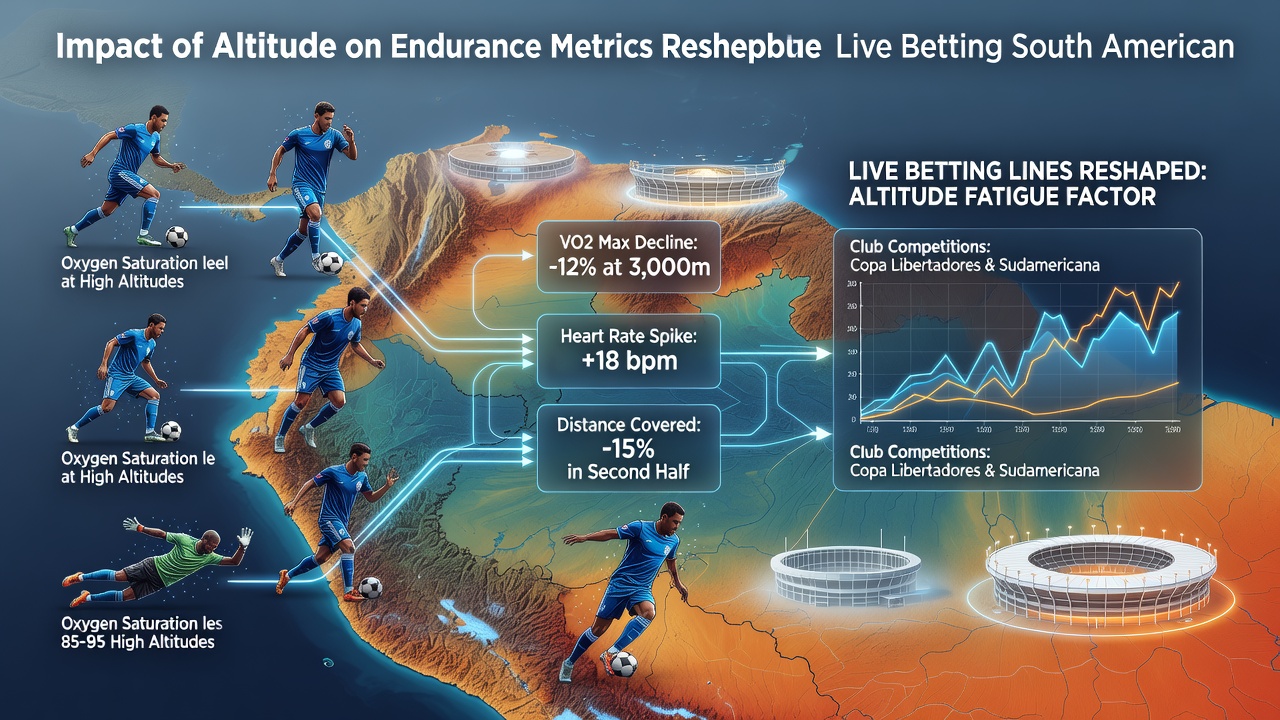
Stadiums perched above 2,500 meters create measurable drops in oxygen availability that alter how long players maintain high-intensity efforts throughout matches in leagues across Bolivia, Ecuador, and Peru. Data collected from CONMEBOL competitions shows visiting teams from coastal regions cover 8 to 12 percent less total distance in the second half when playing at venues such as Estadio Hernando Siles in La Paz, while home sides maintain steadier sprint frequencies.
Physiological Measurements Behind Performance Shifts
Researchers tracking heart-rate recovery and blood-oxygen saturation levels have documented faster lactate accumulation among players unacclimatized to elevation, which reduces repeated sprint capacity after the 60-minute mark. Studies conducted at the Universidad Mayor de San Andrés indicate that maximum voluntary contraction in lower-limb muscles declines more sharply after 70 minutes for athletes arriving from below 1,000 meters, creating predictable windows where teams concede possession or defensive structure.
These changes register directly in event data feeds used by betting operators, prompting live lines on total corners, player tackles, and goal timing to adjust within minutes of observed fatigue spikes. One match analysis from the 2025 Copa Libertadores group stage revealed a 15 percent increase in stoppage time and a corresponding shift in over-under markets once cumulative high-intensity running dropped below a threshold identified in pre-match modeling.
Club Competition Patterns Across Different Elevations
Teams based permanently above 2,800 meters post lower average possession retention when traveling to sea-level venues, yet they record elevated pass-completion percentages during home fixtures against lowland opponents. August 2026 schedules for the Copa Sudamericana feature several such cross-elevation ties, including matches scheduled at Cuzco and Quito that historically produce wider margins in expected goals after the 75th minute compared with equivalent fixtures at lower sites.
Coaches have adjusted substitution timing in response, with data from multiple Bolivian clubs showing earlier introduction of midfield replacements who preserve ball-progression metrics. Such tactical adaptations appear in aggregated statistics released by domestic federations and feed into algorithms that recalibrate in-play probabilities for assists and progressive passes.

Integration With Live Betting Data Streams
Operators monitoring real-time GPS and optical tracking feeds incorporate elevation-specific endurance curves into their models, allowing rapid recalibration of lines on cards, throw-ins, and goal-kick sequences once cumulative player workload exceeds benchmarks. Figures from regional analytics providers show that live markets on matches at altitude experience 20 to 25 percent higher revision frequency between the 60th and 85th minutes than comparable games played under 500 meters.
Academic papers examining match files from the Ecuadorian Serie A between 2023 and 2025 note that visiting sides register increased foul counts in the final quarter as neuromuscular fatigue sets in, information that directly influences in-play pricing on disciplinary markets. Observers note these patterns repeat across multiple venues and seasons, providing consistent inputs for statistical engines used by professional trading desks.
Seasonal Considerations for 2026 Competitions
With several South American club tournaments scheduled through the southern hemisphere winter, temperature differentials combine with altitude to amplify hydration demands and recovery intervals between games. League reports indicate that teams playing consecutive high-elevation fixtures within five days show measurable declines in total distance covered during the second encounter, a variable already embedded in pre-match simulations circulated among data vendors.
Coaches and analysts therefore examine historical second-half metrics from similar fixture congestion periods to project when possession and chance-creation rates diverge from baseline expectations, prompting corresponding adjustments in live lines.
Conclusion
Altitude-induced changes in endurance metrics supply objective inputs that operators and traders incorporate into dynamic pricing across South American club competitions. Consistent tracking of distance, sprint volume, and recovery indicators allows markets to reflect observed physiological responses rather than static pre-match assumptions, resulting in more frequent line movements once matches progress past the hour mark.